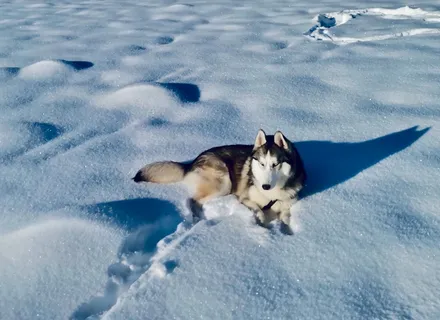
Halton winters are cold enough that frostbite and hypothermia in dogs are real and predictable, not rare. Frostbite typically affects ear tips, tail tip, and paws (the areas with thinnest skin and weakest circulation), while hypothermia develops in any dog that gets too cold for too long. Both conditions need specific first-aid (correctly), and rubbing, direct heat, or alcohol all make things worse. This guide covers the signs, the right rewarming technique, when to call Burlington Veterinary Emergency Hospital (BVERH) at (905) 637-8111, and how to prevent both during the coldest months.
What to Do in the First 10 Minutes
For frostbite
- Move the dog to a warm, dry indoor space.
- Inspect ear tips, tail tip, paw pads, and any thinly-furred areas for pale, grey, or bluish-white skin that feels cold and hard.
- Rewarm gently with warm (not hot) water at 40 to 42°C for 15 to 20 minutes, or hold the affected area against bare warm skin (your hands, your stomach).
- Do not rub, massage, or apply direct heat (heating pad, hairdryer, fire, stove). Rubbing damages fragile tissue; direct heat causes burns to already-injured tissue.
- Pat dry gently after rewarming. Do not rub with a towel.
- Wrap the dog in dry blankets to maintain warmth.
- Call BVERH at (905) 637-8111 for any significant frostbite. The full extent of tissue damage is often not visible for 24 to 72 hours, and a vet visit allows for appropriate pain management and prevention of secondary infection.
For hypothermia
- Get the dog indoors and out of cold or wet conditions immediately.
- Take a rectal temperature if you have a digital thermometer. Normal is 38.3 to 39.2°C. Below 38°C is mild hypothermia; below 32°C is severe.
- Wrap in warm dry blankets from a dryer if possible. Cover the body, neck, and head but leave the face accessible.
- For severe cases, place wrapped warm water bottles (towel-wrapped to prevent burns) against the dog’s belly, armpits, and groin.
- Do not use a heating pad directly on the dog (burns), do not submerge in a hot bath (can cause shock or arrhythmia), and do not give alcohol or food.
- Offer warm (not hot) water to drink if the dog is alert.
- Call BVERH at (905) 637-8111 for any case beyond mild shivering, especially if the dog is weak, confused, or unresponsive.
The full Burlington emergency contact list and other winter-specific resources are on our pet emergency page.
Recognizing Frostbite
Frostbite happens when skin and underlying tissue freeze. Ice crystals form inside cells, blood flow stops, and tissue dies if not rewarmed in time.
Most-affected areas:
- Ear tips
- Tail tip
- Paw pads and between toes
- Scrotum in intact males
- Nipples in nursing females
- Any thinly-furred or exposed area
Early signs:
- Pale, grey, bluish-white, or waxy-looking skin
- Cold to the touch
- Hard or firm tissue
- Numbness (the dog does not react to gentle handling of the area)
During rewarming:
- Red or flushed appearance as blood returns
- Swelling
- Pain (the dog may yelp or pull away)
- Sometimes blistering
Days after the event (if tissue damage is severe):
- Black discolouration
- Tissue death and sloughing
- Sometimes amputation needed for severely affected ear tips or tail tips
Mild frostbite (the most common) often heals fully with rewarming and supportive care. Severe frostbite can result in permanent tissue loss.
Recognizing Hypothermia
Hypothermia means core body temperature has dropped below normal. Dogs lose heat through wet fur, cold ground contact, wind, and prolonged exposure.
Normal body temperature: 38.3 to 39.2°C (101 to 102.5°F)
Mild hypothermia (32 to 35°C / 90 to 95°F):
- Shivering, sometimes intense
- Weakness, slowness
- Pale gums
- Stiff muscles
- Withdrawn behaviour
- Slow heart rate
- Slow breathing
Moderate hypothermia (28 to 32°C / 82 to 90°F):
- Shivering may stop (a bad sign, not a good one)
- Severe weakness or inability to stand
- Confusion, stupor
- Pupils slow to respond
- Significantly slowed heart rate
- Significantly slowed breathing
Severe hypothermia (below 28°C / 82°F):
- Loss of consciousness
- Very slow, shallow, or undetectable breathing
- Very slow or irregular heartbeat
- Cardiac arrhythmia
- Dilated pupils
- Risk of cardiac arrest
Severe hypothermia is a true emergency. Drive to BVERH at (905) 637-8111 while warming the dog en route with blankets.
Rewarming pitfalls
Do not warm the dog too quickly. Rapid rewarming can cause “rewarming shock” with arrhythmia and circulatory collapse. The goal is gradual warming, roughly 1°C per hour for moderate to severe cases. This is hard to achieve at home for serious cases, which is why vet care is important.
Do not apply heat to the limbs first. Limb rewarming pulls cold blood from the extremities into the core, dropping core temperature further. Warm the trunk first (belly, armpits, groin) and the limbs naturally rewarm.
Do not give alcohol. The old myth that brandy warms you up is exactly backwards: alcohol dilates surface blood vessels and accelerates heat loss.
High-Risk Dogs in Halton Winters
Highest risk:
- Small dogs (less mass means faster heat loss)
- Short-coated and single-coated breeds (Italian Greyhound, Whippet, Chihuahua, Frenchie, Pug, Pit Bull mixes)
- Puppies (less developed temperature regulation)
- Senior dogs (less efficient thermoregulation)
- Dogs with chronic illness (diabetes, kidney disease, heart disease, hypothyroidism)
- Underweight or thin dogs
Lower risk but not immune:
- Double-coated breeds (Husky, Malamute, Newfoundland, Bernese, Samoyed, German Shepherd, Golden, Lab)
- Acclimatized outdoor working dogs
Any wet dog loses heat 25 times faster than a dry dog. Even a thick-coated Husky in soaked fur is at risk.
Burlington Winter Safety Routine
Before walks:
- Coat for small, short-coated, senior, or underweight dogs below -4°C
- Booties or paw balm for ice melt and cold pavement
- Check the wind chill, not just the temperature
- Plan walk length appropriate to conditions
Walking guidelines:
- Above -4°C: most dogs fine for normal walks
- -4°C to -10°C: small/short-coated dogs need coats, shorter walks
- -10°C to -20°C: all dogs need coats, limited time outside
- Below -20°C: bathroom breaks only for most dogs
During walks:
- Watch for lifted paws, hunched posture, shivering, reluctance to walk: all signs to head home
- Avoid frozen ponds and lake edges (drowning and hypothermia risk together)
- Watch for road salt and antifreeze puddles (see our antifreeze poisoning guide)
After walks:
- Wipe paws with a damp warm cloth to remove salt and ice
- Dry the dog thoroughly if they got wet
- Check between toes for ice balls
- Inspect ear tips and tail tip for early frostbite signs
Outdoor time:
- Never leave a dog outside unattended in cold weather, even in a fenced yard
- Doghouses are not adequate shelter in Ontario winters
- Always provide unfrozen water if outside for any extended time
What the Vet Will Do
For frostbite
- Pain management with opioids.
- Wound care for affected areas, often including topical aloe vera and silver sulfadiazine.
- Antibiotics to prevent secondary infection.
- Bandaging for severe cases.
- Surgical debridement or amputation for severely damaged tissue once the extent is clear (typically 1 to 3 weeks after the injury).
For hypothermia
- Active core rewarming with warmed IV fluids, warm air blankets, and warm water lavage in severe cases.
- Cardiac monitoring for arrhythmias.
- Bloodwork to assess for metabolic complications.
- Treatment of underlying issues (frostbite, dehydration, secondary infections).
- Hospitalization for moderate to severe cases until temperature is stable.
Cost: outpatient frostbite treatment runs roughly $400 to $1,500. Severe frostbite with debridement or amputation is $2,000 to $5,000+. Severe hypothermia treatment in ICU runs $1,500 to $4,000 depending on severity and length of stay.
The complete Burlington emergency resource list is on our pet emergency page. For broader winter dog care including ice melt safety, antifreeze, and frozen water hazards, see our winter pet care guide for Halton.
Cold-weather dog emergencies are some of the most preventable in vet medicine, because owners control the exposure. Match coat protection and walk length to the conditions, keep the dog dry, watch for early signs of trouble, and the worst-case scenarios rarely happen. When they do, gentle rewarming and a vet call handle most situations safely.