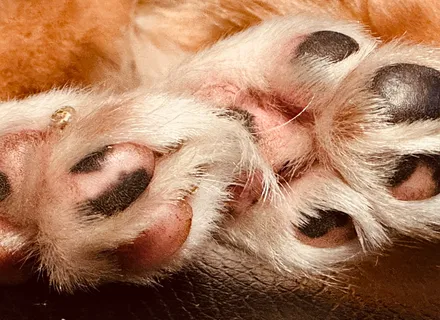
A cracked or torn dog nail looks dramatic because the foot is well-supplied with blood and even a small bleed makes a visible mess. In most cases it is painful but not a true emergency, and you can stop the bleeding at home with direct pressure plus styptic powder, cornstarch, or flour. The vet trip becomes necessary when the nail is fractured at the base, torn off completely, exposing the quick, or when bleeding does not stop within 15 minutes. This guide gives you the exact technique, when home care is fine, and when to call ahead to Burlington Veterinary Emergency Hospital (BVERH) at (905) 637-8111.
Stop the Bleeding in 4 Steps
- Direct pressure for 2 to 3 minutes. Use a clean cloth, paper towel, or gauze. Press firmly on the nail tip. Do not peek, lifting the cloth interrupts clotting.
- If still bleeding, apply styptic powder. Pour a small mound on a flat surface, dip the nail tip into it, and press for 30 seconds. Standard brand is Kwik-Stop or Quick Stop, available at any pet store and useful enough to keep in your first-aid kit.
- If you do not have styptic powder, use cornstarch or flour the same way. Press a pinch onto the nail tip and hold for 30 seconds. Plain bar soap also works in a pinch (rub the nail directly against a dry bar).
- Keep the dog still for the next hour. No walks, no zoomies, no licking. A short rest on a towel-covered bed is ideal. If the dog is determined to lick, fit an inflatable collar or improvise a sock taped above the ankle.
If bleeding is still actively flowing 15 minutes after applying pressure plus styptic, call BVERH at (905) 637-8111 or your regular vet.
When Home Care Is Enough
A nail injury can be managed at home if:
- Bleeding stops within 5 to 10 minutes with direct pressure plus styptic
- The dog is bearing weight on the paw within 30 minutes
- The break is in the visible nail (not at the base where the nail meets the toe)
- No bone is visible
- The dog is otherwise normal (eating, drinking, alert)
- You can keep the paw clean and the dog from licking for the next 24 hours
In these cases, monitor for the next 5 to 7 days. The cracked end of the nail will gradually break off as it grows out, or you can have it trimmed at the next grooming or vet visit.
When to Call the Vet
A nail injury needs professional attention if:
- The whole nail is torn off (exposing the bed underneath)
- The break is at the base of the nail
- You can see pink, red, or grey tissue (quick or bone) at the break
- Bleeding restarts repeatedly despite pressure and styptic
- The dog is in significant pain (whimpering, refusing to bear weight after the first hour, snapping when you approach the foot)
- Swelling, heat, redness, or discharge develops in the next 1 to 3 days (signs of infection)
- The nail is bleeding from a dog with a clotting disorder, on anticoagulant medication, or recently exposed to rat poison (call BVERH immediately for any of these)
For these scenarios, your regular vet during business hours is usually appropriate. BVERH at (905) 637-8111 is for after-hours or if your vet cannot see you the same day. The vet will typically trim the damaged portion cleanly, flush the area, prescribe a 5 to 7 day course of antibiotics, and sometimes a short course of pain medication.
The full Burlington emergency contact list is on our pet emergency page.
Why Nail Injuries Happen
The most common scenarios for cracked or torn nails in Burlington dogs:
- Long nails catching on carpet, throw rugs, or fabric upholstery. The most preventable cause. If you hear a click on hard floors, nails are too long.
- Running on rough ground or trail surfaces. Burlington trails (Bruce Trail, Mount Nemo, conservation areas) have gravel and exposed roots that can catch a nail.
- Slipping on ice. Winter walks. Nails take twisting force when paws slip.
- Jumping off furniture onto hard floors. Repeated impact stress.
- Improper nail trim at home that hit the quick. Bleeds are usually mild and stop quickly with styptic.
The single biggest risk factor is long nails. Long nails change the angle of the toe joints, put extra leverage on the nail base, and catch on everything. Our dog nail trimming guide walks through home technique and how often to trim.
Preventing Infection
Once bleeding stops, the goal is keeping the nail bed clean for the next 5 to 7 days.
- Limit walks in mud, sand, salt, or wet grass for the first 48 hours.
- Avoid baths for the first 48 hours. Tissue heals faster when dry.
- Watch for swelling, heat, redness, or discharge at the nail base. Any of these warrants a vet visit.
- Discourage licking. Dogs lick injuries as a self-soothing response, but saliva introduces bacteria and slows healing. An inflatable e-collar or a clean sock taped above the ankle works for most dogs.
- If walking is required for bathroom breaks, a dog bootie or temporary wrap protects the nail. Remove and air the foot whenever indoors.
When a Cracked Nail Is Actually an Emergency
The vast majority of nail injuries are minor. Two scenarios are real emergencies:
-
Bleeding that does not stop after 15 minutes of pressure plus styptic. This may indicate a clotting disorder, a deeper injury than expected, or exposure to anticoagulant rodenticide. Call BVERH immediately.
-
Pale or grey gums, weakness, or wobbliness alongside a bleeding nail. A small nail bleed should not cause systemic signs. If your dog is acting unwell, the nail may not be the only problem. Drive to BVERH at 775 Woodview Road.
Stock Your First-Aid Kit
Three items handle most dog nail injuries:
- Styptic powder (Kwik-Stop or Quick Stop)
- Self-adhesive bandage wrap (Vetwrap or equivalent)
- Non-stick gauze pads
Total cost under $20 at any pet store. Worth the shelf space. The kit also covers minor cuts and paw pad scrapes.
The complete Burlington emergency resource list is on our pet emergency page. For more on routine paw and nail care, see our nail trimming guide.
A bleeding nail looks worse than it is. Direct pressure, styptic powder, and an hour of calm rest handle most cases. The vet visit becomes important when the break is severe, bleeding does not stop, or signs of infection develop in the following days. Keep a small first-aid kit on hand and you will handle this confidently when it happens.